


April 13th, 2026
Building Bridges for Exchanges and Mutual Learning Through Dialogue Among Civilizations
Recently, Xiao Wunan, Vice Chairman of the China Association of Social Economic & Cultural Exchange, headed a delegation comprising Zou Jianhua, the Deputy Secretary General of the Asia Pacific Strategic Dialogue Organizing Committee, and Chairman of Dalian Jianhua Group, and Gao Jia, Deputy Secretary General of the Asia Pacific Exchange & Cooperation Foundation (APECF). At the invitation of multiple institutions, the delegation visited Paris, Madrid, Casablanca and Hong Kong to deepen cooperation on exchanges and mutual learning between Eastern and Western civilizations, yielding fruitful outcomes.

Xiao Wunan (third from left), Zou Jianhua (second from right), Gao Jia (first from right), together with Hans d’Orville, former Deputy Director-General of UNESCO (third from right), and Mehri Madarshahi, Senior Economist of the United Nations (second from left), pose for a group photo at the UNESCO Headquarters.
In Paris, France, the delegation visited the UNESCO Headquarters and met with Hans d’Orville, former Deputy Director-General, and Ms. Mehri Madarshahi, Senior Economist of the United Nations. Accompanied by the new management team, they toured core areas of the Headquarters and gained in-depth insights into the latest practices and plans in cultural heritage protection, dialogue among civilizations, and international cultural cooperation. The two sides held discussions on in-depth mutual learning between Eastern and Western civilizations, coordinated protection of global cultural heritage, and the implementation of cross-border civil exchange projects, reaching a number of points of consensus on cooperation to sustain the joint advancement of civilizational dialogue initiatives.

Duke Ángel Martínez (first from right) held talks with members of the delegation.
In Madrid, Spain, the delegation paid visits to members of the Spanish Congress of Deputies and the Spanish Royal Family, and held multiple meetings with Duke Ángel Martínez. Focusing on the institutional development of people-to-people exchanges between China and Spain, as well as China and Europe, the two sides conducted in-depth consultations on a series of activities including cultural years, joint high-quality art exhibitions, youth exchange visits and academic seminars, and reached several letters of intent for cooperation. This exchange further facilitated channels for non-governmental cultural exchanges between China and Spain, and advanced China-Europe civilizational exchanges from project-based collaboration toward institutionalized co-construction.
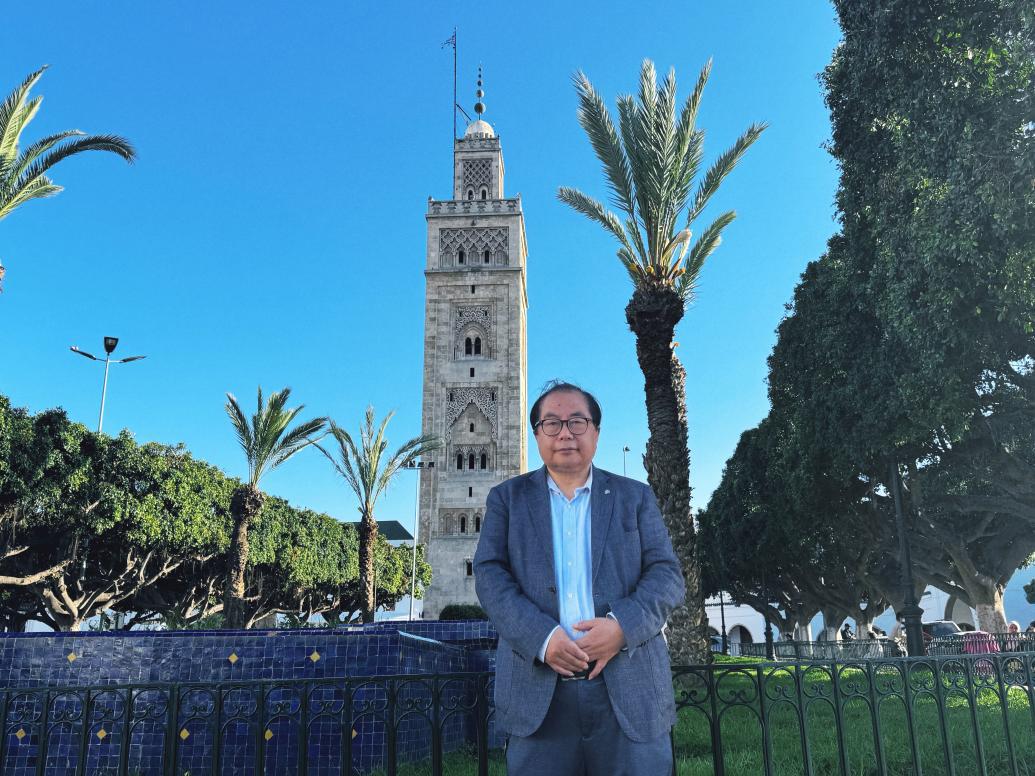
Xiao Wunan inspects world cultural heritage sites in Casablanca, Morocco.
In Casablanca, Morocco, accompanied by local counterparts, the delegation conducted field visits to multiple world cultural heritage sites, with a focus on exploring experience in heritage conservation, restoration technologies and revitalization. Both China and Morocco are ancient civilizations, boasting broad space for cooperation in cultural heritage protection, archaeological research, cultural relic exhibitions and other fields. Consensus was reached on technology sharing, joint archaeological excavations and reciprocal cultural relic exhibitions.

Xiao Wunan (third from left), Zou Jianhua (second from right), Gao Jia (second from left), and Yang Shenzhu (first from left), cultural and creative expert from Taiwan, China, pose for a group photo at Art Basel Hong Kong.
In Hong Kong, the delegation was invited to attend the opening ceremony of Art Basel Hong Kong. The APECF has maintained long-term strategic cooperation with the Art Basel organization based in Switzerland, which facilitated the launch of this fair in Hong Kong. During the exhibition, leveraging this international art platform, the APECF held discussions with numerous art institutions and cultural enterprises, securing important cooperation agreements covering cross-border art exhibitions, international artist residencies, joint development of cultural IPs and digital cultural innovation. It uses art as a bond to foster deep integration of Chinese and foreign cultures.
In March 2014, President Xi Jinping delivered a speech at UNESCO Headquarters, systematically elaborating the vision of exchanges and mutual learning among civilizations. The APECF responded promptly and launched the series of events “Promoting World Peace through Dialogue among Civilizations”, which toured more than ten countries and regions. It has successfully incorporated the theme into the United Nations post-2015 development agenda, becoming an iconic global initiative for civilizational exchange. Among its milestones: in August 2015, the APECF hosted an event in Kuala Lumpur, Malaysia, gathering nearly a hundred statesmen and cultural figures from over twenty countries to build consensus for peace through dialogue between China and the Muslim world. In September the same year, the APECF, together with UNESCO’s “Dialogue among Civilizations” and other institutions, initiated and hosted the event “Advancing World Peace through Dialogue among Civilizations” at UNESCO Headquarters. The event attracted political and academic elites from many countries to explore how civilizational dialogue can address global challenges including climate change and extremism, playing a constructive role in world prosperity and stability.
This visit puts into practice the important vision of exchanges and mutual learning among civilizations. At last year’s APEC meeting, the Republic of Korea proposed advancing Asia-Pacific regional cooperation through culture. Singapore, characterized by diversity and inclusiveness, holds unique advantages in cross-cultural communication. China has always been committed to fostering dialogue and mutual trust among different civilizations. It is foreseeable that Asia-Pacific countries will learn from one another, pursue integration and innovation through exchanges, and jointly forge a path toward the prosperity of civilizations.
 Back
